
Free Tour in Istanbul
0,00€
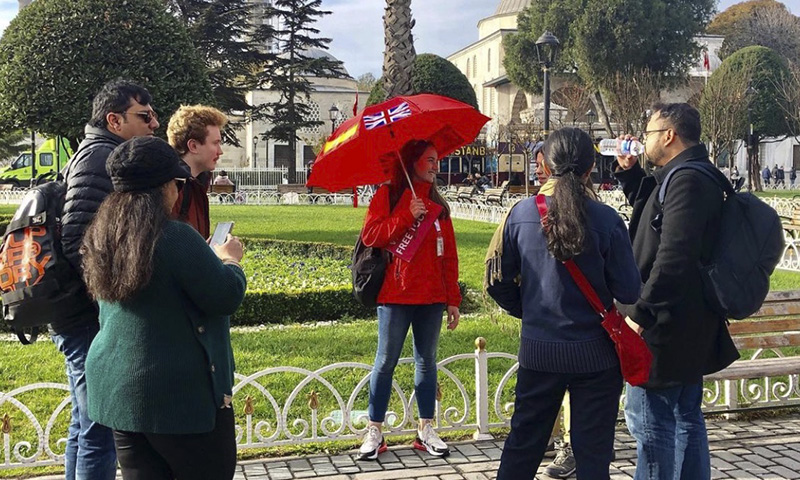
Book Free Tour in Istanbul and get an excellent introduction to the city from professional English-speaking tour guides. Book online now!
Free Walking Tour Istanbul — Daily in English
-
Date/Hour
Every day at 10:30 am, 14:00 pm and 17:00 pm
-
Language
English
-
Duration
2 hours 30 minutes
-
Price
Free — tip your guide at the end (most travellers: €10–20)
-
Meeting point
SULTANAHMET PARKI — decorative circular fountain between Hagia Sophia and the Blue Mosque
-
Itinerary
Blue Mosque, Hagia Sophia, Basilica Cistern, Hippodrome, German Fountain, Topkapi Palace, Soğuk Çeşme Street, Caferağa Madrasa, Arasta Bazaar, Baths of Roxelana
-
End point
PASION TURCA
-
Wheelchair accessible
Yes
What you will see — stop by stop
Every stop on this tour was chosen because it tells a different chapter of the city’s story. Here is what to expect at each one:
- Sultanahmet Parkı. The park that sits between the two greatest buildings in Istanbul. Your guide will give you a brief overview of the neighbourhood before the walk begins — essential context for everything that follows.
- Blue Mosque (Sultanahmet Camii). Completed in 1616 under Sultan Ahmed I, the Blue Mosque was built directly opposite Hagia Sophia in a deliberate act of architectural rivalry. We visit the inner courtyard and explain the significance of its six minarets — a detail that caused a diplomatic incident with Mecca when the mosque was first built.
- Hagia Sophia (Ayasofya). For almost a thousand years, this was the largest cathedral in the world. Then it became a mosque. Then a museum. Now a mosque again. The building has outlasted every empire that claimed it, and its dome — still standing after 1,500 years — remains one of the greatest feats of engineering in history. Entry is free as it is an active place of worship.
- Basilica Cistern. Built by Emperor Justinian in 532 AD to supply water to the palaces of Constantinople, this underground chamber holds 336 marble columns and once stored 80,000 cubic metres of water. Two columns rest on carved Medusa heads placed sideways and upside-down — nobody agrees on why.
- Hippodrome of Constantinople. Once the social and political heart of the Byzantine Empire, the Hippodrome held chariot races watched by 100,000 people. Three ancient monuments still stand here: the Egyptian Obelisk of Thutmose III (brought from Luxor in 390 AD), the Serpentine Column (looted from Delphi after the Persian Wars), and the Column of Constantine.
- German Fountain. A small but curious monument — a neo-Byzantine kiosk with gilded mosaics inside the dome, gifted by Kaiser Wilhelm II to Sultan Abdülhamid II in 1900 to celebrate the Kaiser’s state visit to Istanbul. The mosaic medallions inside show the intertwined monograms of both rulers.
- Topkapi Palace exterior. For four centuries, this complex was the administrative centre of the Ottoman Empire. We walk through the outer gardens and past the Imperial Gate — the threshold that only sultans could cross on horseback. Entry to the interior is not included in the free tour but is well worth a separate visit.
- Soğuk Çeşme Street. A narrow lane of restored Ottoman timber-frame houses from the 18th century, running alongside the outer walls of Topkapi. One of the few streets in Istanbul that gives a genuine sense of what the city looked like before modernisation.
- Caferağa Madrasa. Built by Mimar Sinan in 1559 — the same architect responsible for the Süleymaniye Mosque — this theological school now houses workshops for traditional Turkish crafts: calligraphy, paper marbling (ebru), hand-painted ceramics and glasswork.
- Arasta Bazaar. A covered market built in the early 17th century specifically to generate income for the Blue Mosque. Less crowded and more curated than the Grand Bazaar, it is one of the best places in the city to buy quality Turkish textiles, ceramics and jewellery without the hard sell.
- Baths of Roxelana (Haseki Hürrem Bath). Commissioned by Suleiman the Magnificent for his wife Roxelana in 1556 and designed by Mimar Sinan. One of the finest examples of Ottoman hammam architecture in the city.
- Pasion Turca. End of the tour. Tip your guide here based on your experience of the morning or afternoon. The amount is entirely up to you.
Important: All monuments are visited from the outside unless stated. Hagia Sophia may be entered for free. A break is included mid-tour for rest, washrooms and refreshments.
What makes Viaurbis different from every other tour company in Istanbul
There are dozens of walking tour operators in Sultanahmet. Here is why travellers who compare them choose Viaurbis:
- Six people maximum. This is the single most important thing we do. A guide with six people gives better explanations, answers more questions and moves faster than a guide managing twenty-five. We have kept this limit since 2014 and have no intention of changing it.
- Guides who work in English, not guides who speak English. There is a significant difference. Our guides think, joke, explain and improvise in English. They do not translate from Turkish in their heads before speaking.
- The tour does not get cancelled. Not for rain. Not for cold. Not for low bookings. We have run this tour every single day since 2014. Come prepared for the weather and the tour will go ahead.
- We are the operator. When you book with Viaurbis, you are booking with the company that hires the guides, sets the standards and takes responsibility for your experience. There is no layer between you and us.
- TURSAB licence nº 10841. Officially regulated by Turkey’s tourism authority. Not a side project — a professional operation with a decade of continuous trading.
Booking directly vs. GetYourGuide and Viator — what actually changes
Viaurbis tours appear on GetYourGuide and Viator. The same guides, the same route, the same departure times. But booking through a platform is not the same as booking with the operator. Here is the practical difference:
| Viaurbis direct | GetYourGuide / Viator | |
|---|---|---|
| Price for paid tours | Operator price | + platform commission |
| Who answers your questions | The people running the tour | Platform support team |
| Group size guarantee | Max. 6 — enforced | Platform does not control this |
| Changes or special requests | Handle directly | Via platform ticket system |
| Verified operator | TURSAB nº 10841 | Platform vetting only |
For the free tour specifically, there is no price difference either way — it is free. But for paid tours, booking at viaurbis.com means paying the operator’s rate without a platform margin on top. And if anything goes wrong before or during the tour, you reach us directly — not a helpdesk in another country. Viaurbis is registered with TURSAB under licence nº 10841.
Before you book — answers to the questions that actually matter
Is the free tour genuinely free or is there a catch?
It is genuinely free to join. No deposit, no minimum tip, no upselling during the tour. At the end, you pay your guide whatever you think the experience was worth — or nothing, if that is your decision. The model works because guides who earn from tips are more motivated than guides on a fixed salary. Our 9.9/10 rating across 263 reviews suggests the motivation is working.
Why are groups limited to six people?
Sultanahmet is one of the most visited neighbourhoods in the world. Large tour groups move slowly, block pavements and make it impossible for guides to have real conversations with participants. At six people, your guide can hear your questions, adapt the level of detail to your interests and take you to spots that a group of twenty cannot access. We have maintained this limit since 2014 — it is the single decision we are most proud of.
What level of English do the guides speak?
Professional working level. Our guides spend 2–3 hours a day speaking English to groups of travellers from the UK, USA, Ireland, Australia and beyond. They handle accents, slang, technical historical terminology and off-script questions without hesitation. Several of our guides have lived or studied in English-speaking countries.
Is it worth taking the free tour if I am only in Istanbul for one day?
Yes — arguably more so. Sultanahmet is dense with monuments that look similar from the outside. Without context, Hagia Sophia is an impressive building. With context, it is 1,500 years of religious and political history compressed into a single dome. Two and a half hours with a good guide saves you hours of guesswork with a map and gives you a framework for everything else you see in the city.
What should I bring?
Comfortable shoes — the route covers cobblestone streets and uneven ground. A layer for the mosques, where covered shoulders and knees are required for entry. Water, especially in summer. A small amount of cash in a lower denomination for tipping at the end. Everything else is optional.
Can I enter Hagia Sophia during the tour?
Yes. Hagia Sophia is a functioning mosque and entry is free of charge for all visitors. Our guide will explain what you are looking at before you enter. Note that shoes must be removed and shoulders and knees must be covered — your guide will advise on the spot. The Basilica Cistern and Topkapi Palace require separate paid entry tickets and are not visited from inside on the free tour.

Benedetta Pisano –
★★★★★
My guide was Salih Ylmaz for a free tour in Istanbul. He was very friedly and clear. Book a tour with him in your first day! He give you a lot of interesting and useful tips about city, trasport, museum ti visit. I Hope i’ll come back in instabul!
Benedetta –
★★★★★
Our guide was Salih Ylmaz for a tour in Istanbul. He was very friendly, clear and give us many useful and interesting tips about city, transport and places to visit. Do It on first day of you holiday!
Nico and Mateo –
★★★★★
Pinar was our guide who went above and beyond, not only sharing her knowledge of the historical landmarks but extending to do’s and don’ts during your time in Istanbul. She was always open to questions and made istanbul feel like home. Will def recommend her to anyone visiting.